
The Global Day of Community Restoration
- Activation Days
- Social Impact
- Contact Us
- …
- Activation Days
- Social Impact
- Contact Us

The Global Day of Community Restoration
- Activation Days
- Social Impact
- Contact Us
- …
- Activation Days
- Social Impact
- Contact Us
Slogan
"Transforming The World, One Action At A Time"
About Us
Welcome to the Global Day of Community Restoration (GDCR), a global movement focused on reconnecting communities and fostering social impact. GDCR was created in response to the growing social disconnection, serving as a monthly reminder to come together and strengthen our communities through kindness, collaboration, and purposeful action.
Held on the 29th of every month, GDCR invites individuals, businesses, and organisations to participate in acts that inspire unity and positive change, whether through volunteering, organizing local events, or simply reaching out to those around us.
At GDCR, we believe small, consistent actions can create profound, lasting social impact. Our mission is to empower everyone, regardless of background or resources, to contribute to a more compassionate and connected world. Join us in making the 29th of each month a symbol of hope, unity, and transformation.
Mission
Our mission is to inspire individuals, communities, movements brands, coporate companies, government bodies, religious groups and institiuions to actively engage in transformative actions that promote unity, compassion, and healing.
Guided by the belief that every individual holds the power to effect tangible change, GDCR seeks to harness the collective consciousness towards a shared vision of a harmonious world. In the spirit of holidays or awareness days like Valentine's Day, International Women's Day, Global Odd Socks Day or National Mint Chocolate day, where societies undergo shifts to accommodate messages to subscribers of that call to action, the GDCR envisions a monthly recalibration of priorities and energies toward communal well-being.
Our mission is clear:
1. Cultivate Unity: GDCR aims to dissolve societal divisions by encouraging individuals, organisations, and communities to set aside differences and actively engage in restoring bonds of unity within their homes and localities by observing the GDCR on the 29th day of every month (official day, 29th October)
2. Inspire Action: Through the 29th day of every month, GDCR propels everyone to take concrete steps towards positive change, leveraging their influence to foster a collective consciousness that echoes the values of community, love, and peace.
3. Global Impact: By transcending geographical boundaries and cultural differences, GDCR strives for a global impact, envisioning a world where each monthly observance contributes to the cumulative healing and restoration of communities worldwide.
4. Encourage Reflection: GDCR advocates for introspection, urging participants to reflect on their roles within the interconnected fabric of society, and how their actions contribute to the collective well-being of humanity.
5. Catalyse Transformation: Guided by the principle that small, intentional acts collectively create significant change, GDCR serves as a catalyst for transformation, propelling individuals and communities toward a more harmonious and compassionate existence.
The Global Day of Community Restoration invites all individuals, regardless of background or affiliation, to join us in this monthly endeavour. Through purposeful actions on the 29th (12 days in total minimum), we aspire to create a ripple effect of positive change, with the ultimate goal of fostering a world where love, unity, and restoration prevail. The 29th of October is the main day of focus where every year there will be a theme.
Even in our busy lives, the Global Day of Community Restoration (GDCR) offers a simple way to make the 29th meaningful by connecting your existing activities or personal moments to this global movement, allowing everyone—individuals and businesses alike—to contribute to positive change without added effort.
Vision
To create a world where every community is united, resilient, and thriving through the power of connection and collective action.
Anyone Can Participate
The 29th is for everyone. It does not matter what your political beliefs are, what community you come from, what faith you follow, how much money you have, or how busy your life is. This movement is built on the simple truth that every human being can strengthen the place they live in, even in small ways.
You do not need permission, a title, a budget, or a role. You do not need to join a group or agree with anyone’s ideology. You only need the willingness to show up for your neighbour, your street, or your community in a way that feels natural to you.
The 29th belongs to all of us — open, accessible, and free from politics, branding, and competition — so anyone can take part, however their life is shaped.
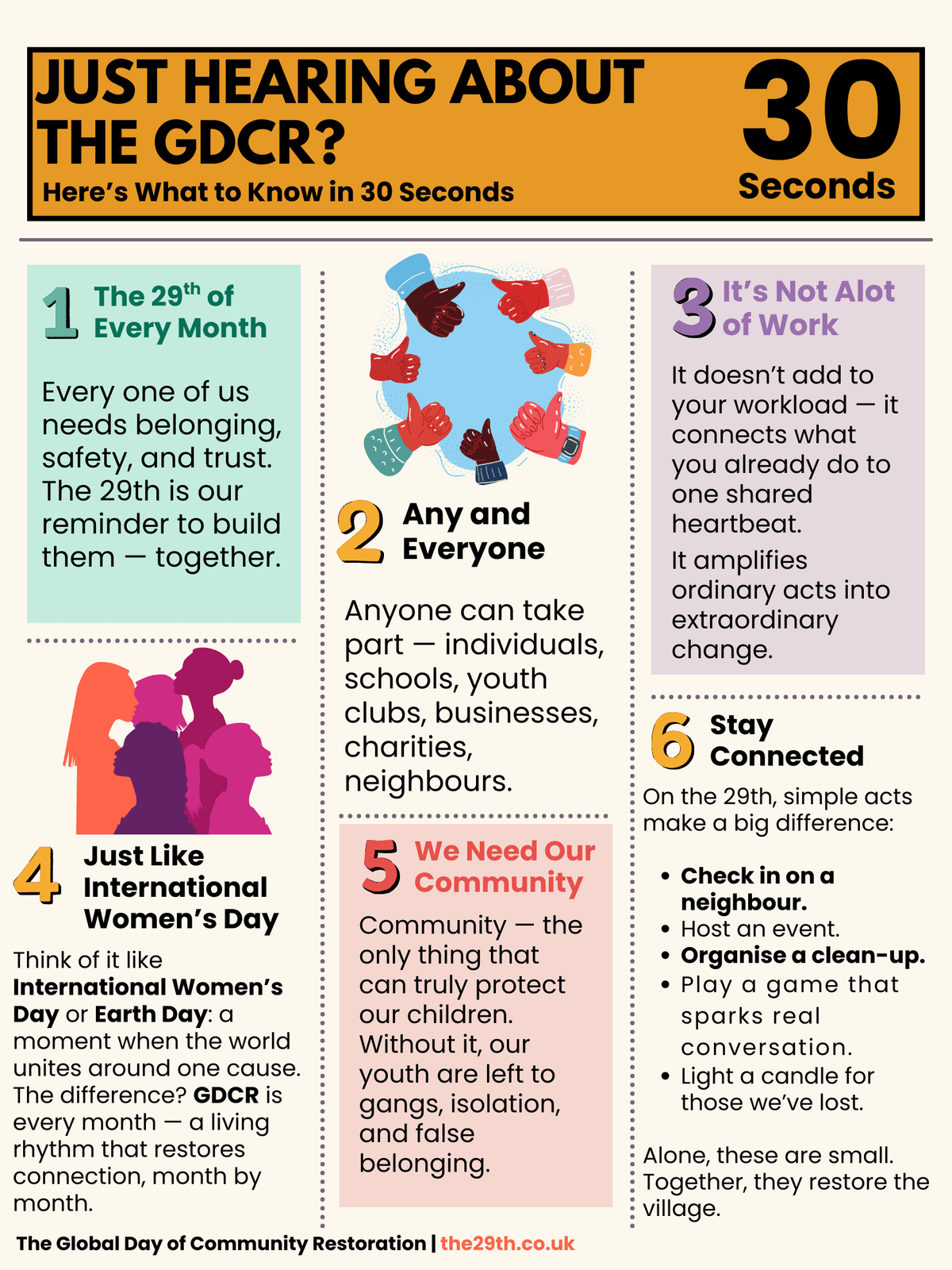
Download
If you want to understand what's at stake and what’s possible, start with the Manifesto. It explains exactly why the 29th matters now more than ever.
FAQs
Here are some frequently asked questions (FAQ) to help you understand more about the Global Day of Community Restoration (GDCR) and how you can get involved in this global movement to strengthen our communities.
It's A Great Idea But I Do Have Time, I Am Way Too Busy
I understand that life is incredibly busy, especially in today's world where the cost of living is rising, work hours are long, and many are balancing multiple jobs just to get by. It can seem daunting to add one more thing to your plate. However, just as people find personal and meaningful ways to celebrate days like Valentine’s Day or International Men’s Day, we believe that you can find your own unique way to observe the Global Day of Community Restoration (GDCR).
We all share the 29th, and it will come and go whether we acknowledge it or not. But imagine the impact we could have if we all made that day a little more meaningful. The beauty of GDCR is that it’s flexible—there’s no one right way to participate. You have complete autonomy to decide how to observe the day in a way that fits into your life, no matter how busy it may be.
If you’re a business owner, the chances are high that you’re already providing valuable services on the 29th. The GDCR doesn’t require you to create something entirely new or outside of your daily operations. Instead, it’s about connecting your preexisting activities to the GDCR mission. Whether it’s offering a small discount, hosting a community-focused event, or simply raising awareness about GDCR, your involvement can seamlessly integrate into what you’re already doing.
Whether it’s a small act of kindness, taking a moment to connect with someone in your community, or organising something larger, your participation matters. Every effort, big or small, contributes to the collective goal of restoring and strengthening our communities. So, as the 29th approaches, I encourage you to think about how you can make it a day of positive change. Together, we can create a ripple effect that will be felt far beyond just one day.
Let’s make the 29th a day we all look forward to—a day where we pause, reflect, and act with intention to bring about the change we wish to see in our world. Whether you’re an individual or a business, your contributions, no matter how integrated into your routine, can make a significant impact on our shared community.
How Do I Get Started?
How To Get started?
Understand the Mission - Familiarise yourself with the goals and values of GDCR. Recognise the importance of creating positive change and strengthening community ties.
Identify Your Passion - Consider what issues matter most to you and your community. What would you like to see happen?
Plan an Activity - Based on your passion, choose one or more activities from the suggested list or come up with your own. Tailor it to the needs and interests of your community
Recruit Participants - Spread the word through social media, local community boards, and word of mouth. Invite friends, family, and neighbours to join you in your chosen activity
Set a Date - While the focus is on the 29th of each month, decide on the month and plan and confirm your event or activity in advance to ensure maximum participation
Gather Resources - Identify what materials, tools, or resources you need for your activity.
Collaborate - Reach out to local organisations, businesses, or community leaders to partner with
you. Collaboration can amplify your efforts and bring more resources to your activity. If they have already signed up to the 29th then this would have happened already
Execute the Plan - On the 29th, carry out your planned activity with enthusiasm and dedication. Make sure to capture the event through photos or videos to share with others
Reflect and Share - After the activity, reflect on the impact it made. Share your experience on social media using GDCR hashtags, and encourage others to participate in future GDCR events.
Commit to Monthly Action - Make the 29th of every month a recurring day for community action. Continue to engage in or plan new activities, and inspire others to join the movement.
What Are Your Strategic Priorities?
GDCR has 5 strategic objectives that guide our movement.
Please note, because they are our priorities they don't limit the areas you can contribute to—every effort counts.
1. Improving Academic Attainment and Promoting Young voices
On the 29th of every month (and beyond), GDCR supports activities that nurture young voices and enhance academic success. We aim to empower the next generation to share their stories, to articulate their needs, enrich our communities, and feel safe and supported in their learning environments.
2. Strengthening Community Connections
We believe it takes a village to raise a child, but in many inner-city areas, the sense of community is fading. We aim to revive and strengthen these connections by fostering collaboration, encouraging networking, and promoting mutual support. Our goal is to build strong, inclusive, and resilient communities where everyone has the opportunity to thrive.
3. Enhancing Happiness and Well-being
On the 29th of every month (and beyond), we promote mental, physical, and emotional health through a variety of initiatives designed to create healthier, happier communities.
4. Promoting Community Safety
On the 29th of every month (and beyond), we encourage activities that advocate for safety initiatives, ensuring all residents feel secure, valued, and protected within their neighborhoods.
5. Developing Family Values
On the 29th of every month (and beyond), we encourage families to strengthen their bonds, build peer networks, and foster deep, meaningful connections that enable everyone to thrive together.
What Type Of Activities Can I Do?
In our diverse and varied village, which includes people of all ages and demographics—doctors, teachers, residents, shopkeepers, sports shops, and tech firms—activities should reflect the unique scope and interests of each, allowing everyone to contribute in their own meaningful way.
You can choose activities that reflect your passions and interests, whether big or small—it's entirely up to you. From organising community events to simply connecting with a neighbour, you have total autonomy to decide how you want to contribute.
If you are someone who is not tied to a organisation you can do something small like
- Organise a Family Meal
- Apologise to Someone
- Connect with a family member or friend
- Self-Care Day
- Dedicate time to your mental, physical, and emotional well-being.
- Volunteer at a Food Bank for example
- Work with neighbours to start a campaign
If you are a local business you could;
- Showcase our logo, host an event, speak about what GDCR means to your brand
- Raise awareness about GDCR and community issues with your team
- Organise training, host a conference
- Sponsor a Community Event
- Offer Discounts for GDCR Participants
- Donate to a Local Cause
- Run a Skills Workshop
- Collaborate with Other Businesses
- Organise a Fundraiser or awareness day
- Share this cause with your customers/clients/those you serve
If you are a local charity, school or institution you could;
- Organise an event
- Organise group yoga or wellness session to promote health and well-being.
- Community clean up
- Students can do arts and crafts, making their community look nice (posters etc)
- Host Intergenerational Discussion
- Run a Mental Health Workshop
- Organise a Sports Event
- Host a Cultural Exchange
What Are Our Guiding Principles?
Our Guiding Principles
- Unity in Diversity - We believe in the power of diversity and inclusion. GDCR is built on the principle that all individuals, regardless of their race, religion, gender, political ideology, or socioeconomic status, have a role to play in the restoration of our communities. We celebrate our differences and use them as a source of strength to foster unity.
- Continuous Improvement - The GDCR is not a one-time event but an ongoing commitment to continuous improvement in our communities. Each 29th day of the month serves as a reminder of our responsibility to contribute to positive change, ensuring that our efforts lead to lasting impact.
- Local Action, Global Impact - We recognise that meaningful change starts at the grassroots level. By encouraging local action, we aim to create a ripple effect that extends across borders, contributing to a global movement of restoration and unity.
- Empowerment and Participation - The GDCR is a platform for empowerment. We encourage active participation from all sectors of society, ensuring that every voice is heard, and every action counts towards the collective good.
- Sustainability and Legacy - Our initiatives are designed with sustainability in mind, ensuring that the positive changes we implement today will benefit future generations. We seek to leave a lasting legacy of restored and thriving communities.
Why The 29th of Every Month?
The 29th Article of the Universal Declaration of Human Rights
The 29th article states that everyone has duties to the community in which they live, emphasising the importance of collective well-being. This article highlights that individuals should contribute to the community's development and respect the rights and freedoms of others. The GDCR embodies this principle by encouraging individuals and communities to actively engage in restoring and revitalising their communities. By participating in GDCR activities on the 29th of each month, people are not only acknowledging their individual responsibilities but also their collective role in fostering a supportive and thriving community
What does "if we do not initiate the youth into the village, they will burn it down just to feel the warmth" mean?
The phrase "if we do not initiate the youth into the village, they will burn it down just to feel the warmth" highlights the crucial role that young people play in the vitality and future of a community. It highlights the importance of engaging and integrating the youth into community life to foster a sense of belonging and responsibility. When our young feel disconnected, undervalued, or ignored, they may respond with disillusionment, apathy, or even destructive behaviours that threaten the community's harmony and sustainability.
This is where the Global Day of Community Restoration (GDCR) becomes vital. GDCR aims to bridge the gap between generations by fostering connections, encouraging active participation, and instilling a sense of purpose among youth. By involving them in community initiatives and meaningful activities on the 29th of each month, we not only empower the younger generation but also strengthen the communal bonds that hold us all together.
Through GDCR, we create opportunities for youth to engage with their community, develop leadership skills, and contribute positively. This initiative emphasises the importance of collective action and encourages everyone, regardless of age, to play a part in restoring the spirit of community. By actively involving the youth in this process, we help ensure a vibrant future for our villages and prevent the metaphorical "burning" that can occur when young people feel marginalised or unsupported.
What About The Leap Year?
In a non-leap year, when February 29th does not occur, the spirit of the Global Day of Community Restoration (GDCR) remains just as strong. Instead of missing out, you can choose to observe GDCR on March 1st or during the final week of February.
Is it for certain communities?
The 29th is for everyone. It doesn’t matter your politics, your background, your faith, or your resources. You don’t need permission, a title, or a budget. You only need the willingness to show up in your own way — checking on someone, connecting, or taking one small action that strengthens your street. The 29th is open, accessible, and free from politics or competition, so anyone can take part and make a difference.
Why does the 29th matter so much?
Reminder! And its worth repeating.... The 29th is not just a date. It is connected to Article 29 of the Universal Declaration of Human Rights, which reminds us that every person has duties to their community. The 29th gives that responsibility a rhythm, a moment, and a shared public expression.
To ignore the 29th is to ignore the article at the heart of the movement. If we do not empower community, what do we do? Keep waiting for systems to fix what only connection, responsibility and belonging can restore? The 29th exists because community cannot remain an afterthought.
What are the 12 Days of Community Activism?
Because GDCR happens every month, the 29th creates 12 Days of Community Activism across the year. These are monthly opportunities for people, families, schools, businesses, community groups, faith spaces and organisations to take one meaningful action that strengthens connection, safety, wellbeing or belonging.
Most awareness days happen once a year. GDCR is different because it returns every month. It is not a one-off campaign; it is a repeated civic rhythm. One year. Twelve moments. One shared commitment to restoring community
Is 29 October the official day?
Yes. The 29th of October can remain the official annual focus day for GDCR, with a larger theme, campaign moment or public push each year. The other monthly 29ths act as smaller activation days that keep the movement alive throughout the year.
This gives the movement two layers: the 29th of every month builds rhythm, while 29 October becomes the major annual moment where the world is invited to focus more deeply on community restoration.
What if the 29th falls on a weekend, school holiday or bank holiday?
That does not weaken the movement. The 29th remains the anchor, but delivery can be flexible. Some people will act on the day itself. Others may activate during the week of the 29th or on the nearest practical date.
The aim is not rigid compliance. The aim is shared rhythm. The 29th gives people something to remember, plan around and return to. Communities should not be punished by the calendar. The meaning stays fixed; the method can flex.
Why not change it to the first Friday or last Friday of the month?
A Friday may be convenient, but it does not carry the same meaning. The 29th links directly to Article 29 and our duty to community. That gives the movement its moral foundation.
Partners who need a weekday structure can deliver on the nearest Friday or during the week of the 29th, but the message should still point back to the 29th. A Friday is a scheduling tool. The 29th is the heartbeat
How is this similar to other activism campaigns?
Campaigns such as 16 Days of Activism against Gender-Based Violence show the power of structured action periods. Hackney CVS describes the aim of 16 Days as improving understanding of harmful behaviour, sharing approaches to supporting people most at risk, and raising awareness of available support.
GDCR learns from that principle but applies it to community restoration. Where 16 Days creates a focused annual window, the 29th creates 12 monthly moments. It turns community restoration from an occasional conversation into a repeated practice.
Will this create extra work for schools, councils and organisations?
It should not. GDCR is not asking organisations to invent a completely new programme. It invites them to align something they already do with a shared monthly rhythm.
A school might hold an assembly during the week of the 29th. A youth group might dedicate its usual session to belonging and restoration. A business might offer a small act of welcome. A council might connect existing community safety work to the 29th. A faith space might use an existing gathering to focus on unity, healing or service.
The 29th does not add pressure. It adds meaning.
Has the idea already been tested with the community?
Yes. GDCR has already been validated through community feedback. In May 2022, the movement spoke with 1,000 residents at Westfield to understand whether people connected with the idea. The feedback showed that people understood the simplicity, urgency and possibility of the 29th.
Those voices matter. If we are serious about community-led change, we cannot ask residents for their views and then dismiss what they say because professionals find the calendar inconvenient. The deeper question is not, “Is this easy for institutions?” The deeper question is, “What should change look like when communities themselves are asking for connection?”
Why is an Ambassador important?
An Ambassador is important because new movements need trusted voices. A mainstream Ambassador can help people understand GDCR quickly, attract attention from influencers, open doors with institutions, and give the movement public credibility.
The Ambassador does not own the movement. They amplify it. Their role is to help convince people that the 29th is serious, urgent and worth joining. A good Ambassador helps answer the question many people quietly ask when they first hear a new idea: “Is this real?” Their presence says, “Yes. This matters. Pay attention.”
Influencers help move attention, and attention helps move culture. This does not only mean celebrities. It includes local artists, youth workers, coaches, barbers, faith leaders, podcasters, teachers, parents, elders and community voices who already carry trust.
Their role is to normalise the question: “What are we doing for the 29th?” When people see others taking part, the idea becomes easier to understand and easier to copy.
What should partners say if people question the fixed date?
Partners can say:
The 29th is the symbolic and human-rights anchor of GDCR. It is rooted in Article 29 and our duty to community. The 29th of October is the official annual focus day, while every monthly 29th creates one of the 12 Days of Community Activism. Delivery can happen on the 29th, during the week of the 29th, or on the nearest practical date. The aim is not rigid compliance; the aim is repeated community restoration until connection becomes culture.
OUR ORIGN STORY
Founded - May 5th 2014
In 2014, a community was shaken by the death of a local teenager. Hundreds gathered for an emergency meeting. The room was full—parents, youth workers, activists, concerned residents, charities, even the police. Emotions ran high. There was grief, blame, frustration. Most of the anger was directed at law enforcement. One by one, community leaders stood to speak. Many represented organisations or projects.
But instead of unity, what emerged was repetition. Each speaker promoted their service or initiative, listing what they offered, how they could help, why they deserved attention. It became clear that although there were more charities and brands than ever before, there was less collaboration, less cohesion, and very little shared purpose.
Bankera sat quietly near the back. He wasn’t a spokesperson or the head of a project. He didn’t have a leaflet to hand out or a solution to propose. He was just a resident. But as he listened, something unsettled him. So many people in the room clearly cared. There were resources, ideas, passion. But everyone seemed to be pulling in different directions. Competing, even. And the deeper crisis—community breakdown—was barely being named.
When he finally stood to speak, Bankera didn’t bring a strategy. He brought perspective. He spoke about the kind of community he had known growing up. A place where neighbours weren’t perfect but were present. Where disputes were followed by dialogue. Where people shared what they had, looked out for one another, and came together in times of need. He reminded the room that safety and strength had once come not from systems, but from each other.
Then, almost without premeditation, he began to share an idea. He spoke about activation days—dates in the calendar that people rally around regardless of background or affiliation. Days like International Women’s Day. Days that are not about one organisation, but about a shared cause. He pointed out that the power of such a day lies in the collective attention it creates. Yet he also noted a weakness: they only come once a year. The energy peaks, then fades. The momentum doesn’t always last.
What if there was a day for community—not once a year, but every month?
He reflected aloud that there didn’t seem to be a day dedicated to community restoration. A day not for campaigns or programs, but for people to remember their shared humanity. A day for action, reflection, reconnection. Not about branding, but about belonging. A chance for people to repair what had been frayed by silence, by violence, by distance.
He suggested the 29th.
Not because it represented anything flashy, but because it was clear, easy to remember, and available. A neutral space in the calendar, free of affiliations. A monthly marker. A recurring opportunity for people to pause and realign.
He called it the Global Day of Community Restoration—GDCR. A day where neighbours could check in with one another. Where elders and youth could gather in circle. Where communities could clean, create, forgive, and build. A shared platform that anyone could contribute to, in their own way. No central leadership, no rigid structure—just an open call to act with intention.
He spoke about the way other major events—like the World Cup—bring together brands, governments, and communities from across the globe. Competitors. Rivals. All pouring into one day. Not because they’re told to, but because the day itself is powerful enough to hold them.
He wondered: what if we treated community like that? What if it deserved that kind of collective energy, not once every few years, but on a regular basis?
He spoke of Article 29 of the Universal Declaration of Human Rights, which states that we all have duties to the community. That it’s within community that we become fully ourselves. GDCR, he said, wasn’t about being perfect. It was about being present. Not about being the expert, but about being willing. Restoration doesn’t need a blueprint—it needs commitment.
He imagined a future where, on the 29th, someone might say, “It’s time to talk.” “Let’s try again.” “What can we build today?” A future where that date becomes a reason to reach out. To show up. To remember.
He didn’t ask the room to follow him. He invited them to see themselves. To recognise their role in what could be a new rhythm of restoration. Twelve chances a year to choose connection over isolation. Twelve chances to act with care.
Something shifted that day. Not with applause, but with clarity. A quiet understanding that the answer was already in the room.
It wasn’t more services. It was more solidarity.
It started with a voice.
A memory.
A vision.
Now, the invitation lives on.
What will you do on the 29th?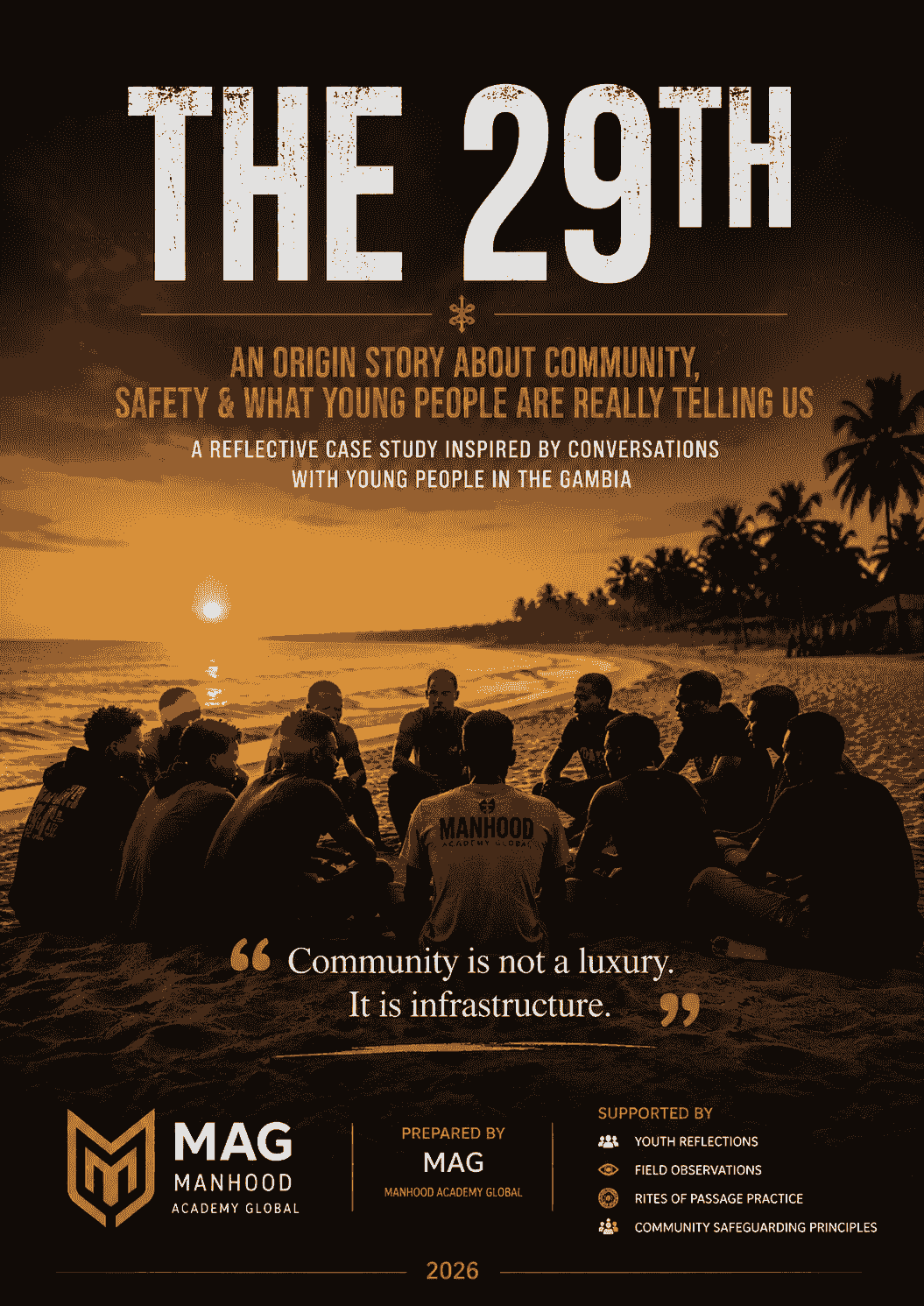
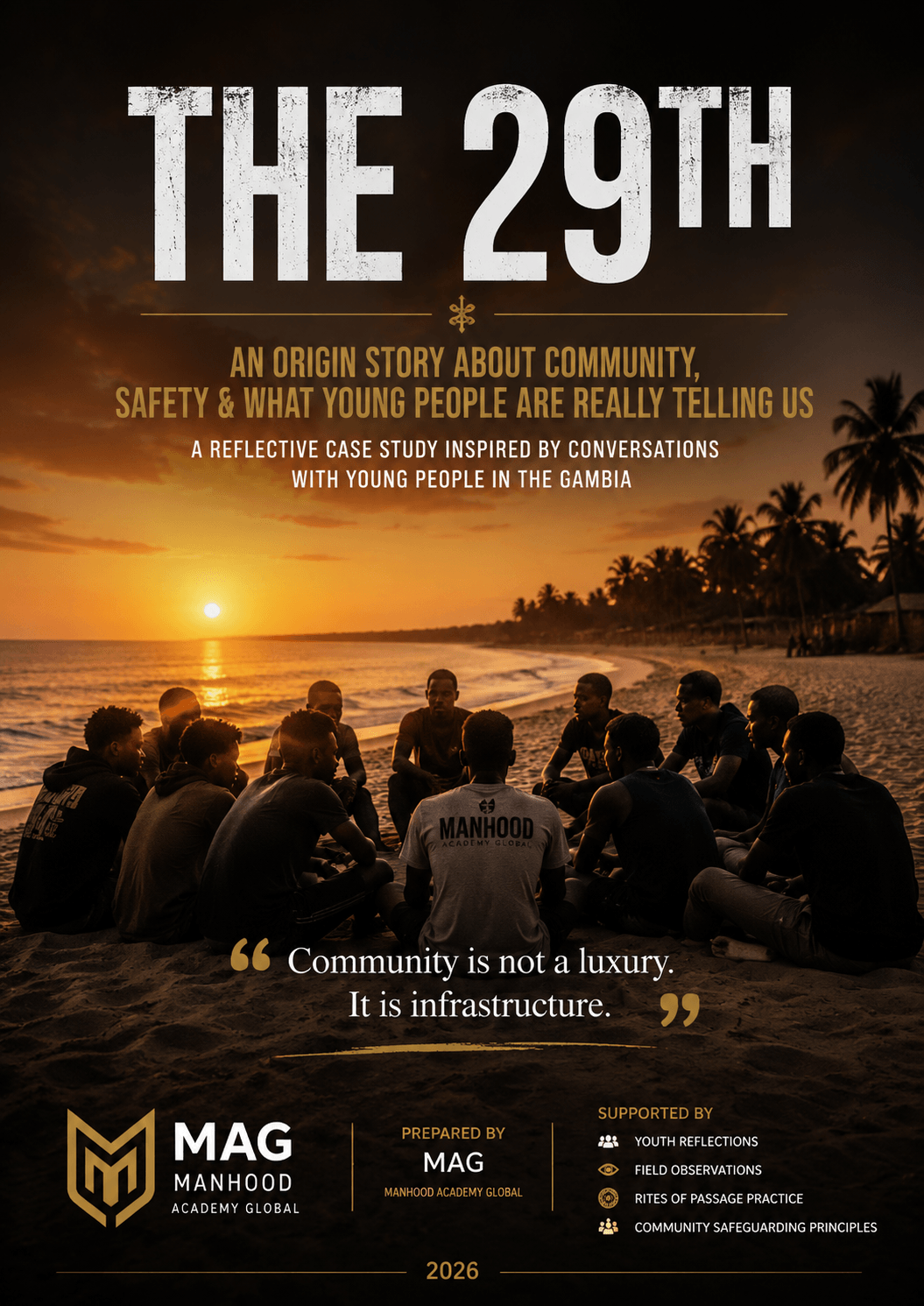
A Reflective Case Study
Inspired By Young People In The Gambia.
Picture This
Your phone rings....... and it's someone you've had a conflict with. Surprisingly, they begin the conversation by saying, "I'm reaching out because it's the 29th. We need to talk about what happened. Can we settle the conflict?"
In that moment, the power of The Global Day of Community Restoration (GDCR) becomes evident. It was just an normal day but now this day has meaning, the 29th is not just a date; it's a catalyst for positive change, a kick-starter for healing and resolution. This person, acknowledging the significance of this day, is using it as an opportunity to mend bridges and move forward.
GDCR provides a unique platform for individuals to set aside differences, even if just for a moment, and engage in meaningful conversations aimed at resolution. It becomes a shared commitment to restoration, a chance to heal wounds, and an invitation to reconcile.
In response, you may find yourself open to the conversation, willing to listen, and ready to contribute to the restoration of harmony. The 29th acts as a shared space, transcending personal conflicts and inviting individuals to prioritise understanding and unity.
By using GDCR as a resolution tool, conflicts can transform into opportunities for growth and understanding. The intentional focus on this specific day allows individuals to move beyond the grievances of the past and work together to create a more harmonious future.
So, imagine that call on the 29th not as a reminder of discord but as an invitation to participate in a shared commitment to resolution and healing. Let the 29th be the day conflicts are confronted, discussed, and ultimately transformed into opportunities for positive change. What will you do on the 29th?
THE GLOBAL DAY OF COMMUNITY RESTORATION