
The Global Day of Community Restoration
- Activation Days
- Social Impact
- Contact Us
- …
- Activation Days
- Social Impact
- Contact Us

The Global Day of Community Restoration
- Activation Days
- Social Impact
- Contact Us
- …
- Activation Days
- Social Impact
- Contact Us
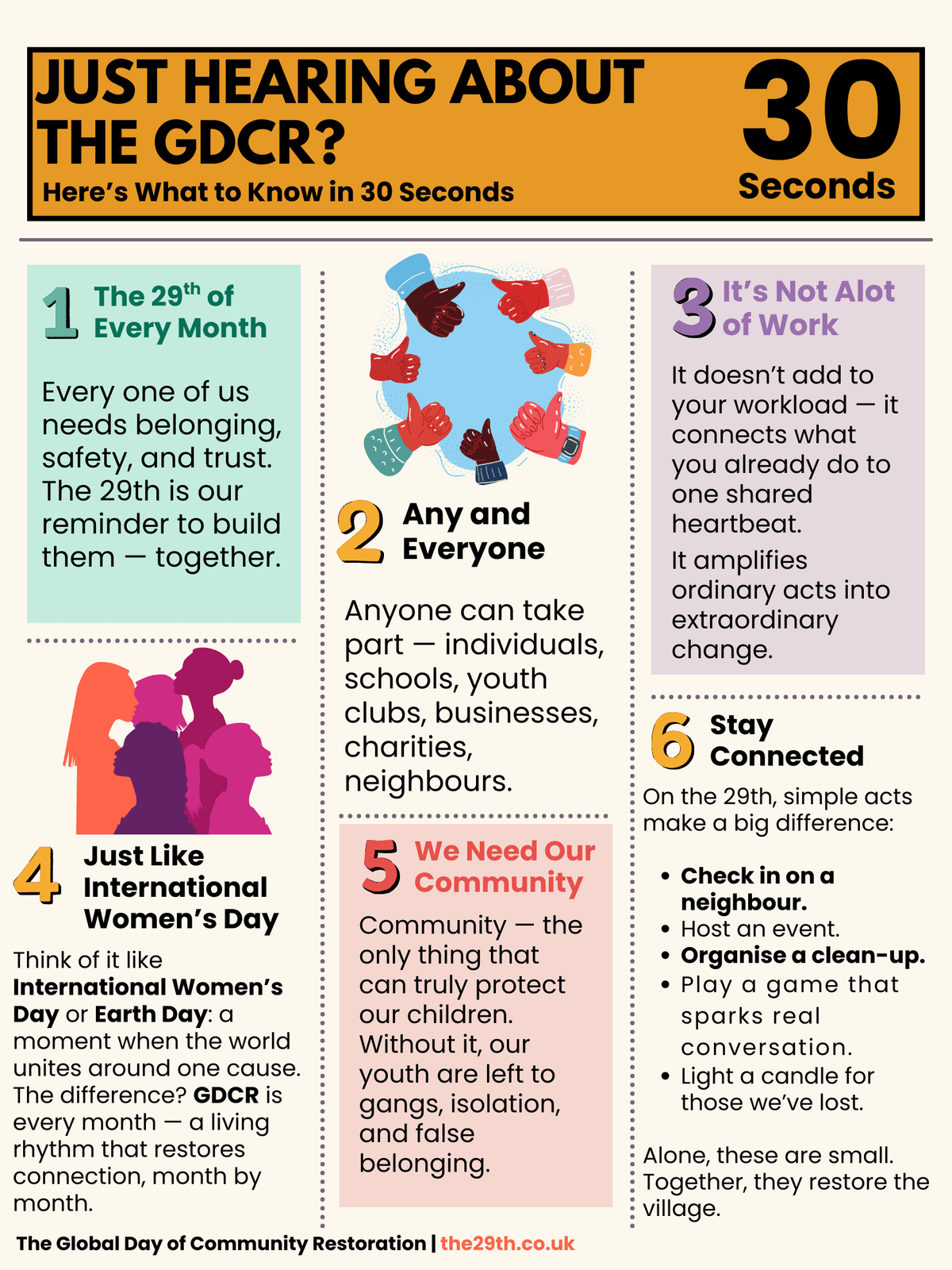
Our Campaign in Under 30 Seconds
What Will You Do On The 29th?
The History of International Days
Across the globe, certain days have been set aside not just to commemorate — but to activate. These are international observance days, established to draw attention to some of the most pressing issues facing humanity and the planet.
The idea dates back nearly a century, but it was in 1947, with the founding of the United Nations, that international days began to take on structured global significance. These designated dates were created to raise awareness, mobilize political will, and inspire action around key themes such as human rights, health, peace, gender equality, and sustainability.
Over time, these days have grown into powerful global moments. Governments mark them with policy announcements. Media outlets give them headline space. Communities organise events. Schools adapt their lessons. And people — often for the first time — feel seen, heard, and invited to be part of something bigger than themselves.
Some of the most impactful international days include:
- International Women’s Day (March 8) – Celebrated in over 100 countries, it amplifies the movement for gender equity and women’s rights worldwide.
- Earth Day (April 22) – Launched in 1970, it's now one of the largest environmental observances globally, with over a billion participants annually.
- World Health Day (April 7) – Used to highlight global health challenges and shape international responses through the World Health Organization.
- World Mental Health Day (October 10) – A growing movement helping to break the silence around mental wellbeing and mental illness.
- International Day of Peace (September 21) – A UN-sanctioned day that invites nations and individuals to cease conflict and promote reconciliation.
These days matter because they create consistency. They give causes visibility. They help communities align their efforts. And they prove that even a single date, when recognised collectively, can shift culture, influence policy, and inspire mass action.
Yet for all these powerful dates on the global calendar, one has been missing: A day for community.
Not just to raise awareness of community issues — but to restore. To repair relationships.
To reduce violence. To rebuild trust.
To reimagine what’s possible when people choose each other over isolation.That’s why the Global Day of Community Restoration (GDCR) was created.
To fill the gap.
To give communities across the world a regular rhythm — a monthly opportunity to reconnect, reconcile, and rebuild.Let me know if you'd like a timeline visual, infographic version, or a carousel-ready format for this content.
Gallery
Photos & videos from our travels




It Doesn’t Matter Who You Are —
the 29th Is for You
It doesn’t matter if you’re a business, a school, a youth group, a faith leader, a community organiser, or simply one person who cares — the 29th is yours to use.
You don’t need funding.
You don’t need permission.
You don’t need to change who you are or what you do.
We pass each other more often than we greet. We offer services but forget to build relationships.We work in silos, even when our missions align. There are more brands and organisations than ever before — yet loneliness, violence, disconnection, and distrust continue to grow.
The 29th is an invitation to interrupt that cycle.
You don’t have to do anything new — just do what you already do, on purpose, on the 29th, and allow your efforts to echo with thousands of others doing the same.
On the 29th…
A business might offer free tea to neighbours, or a space for dialogue.
A youth group might host a clean-up or mural project.
A faith community might open their doors for a circle of peace.
A school might run a kindness wall or intergenerational storytelling session.
A family might invite an estranged relative over for dinner.
A community centre might hold a healing space for local men, women, or youth.
A person like you might send a message that starts with, “It’s the 29th. Can we talk?”
— Alice Johnson
There’s no wrong way to take part — the power is in showing up intentionally, knowing that across the world, others are doing the same.
And that’s the shift.
We begin to restore what’s been broken not through massive campaigns, but through consistent, collective action.
Twelve times a year, every month, the same heartbeat: community matters. And slowly, rhythm becomes culture. Culture becomes change.
The 29th will come, whether we use it or not.So why not let it mean something?
What will you do on the 29th?
— Darryl Duncan


THE GLOBAL DAY OF COMMUNITY RESTORATION